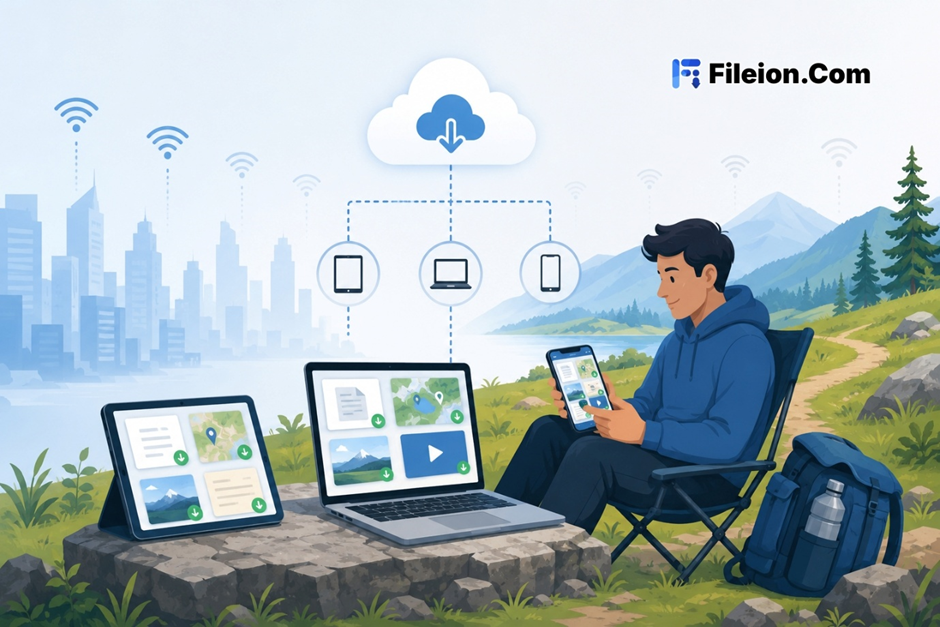
We live in a world that sounds permanently online. 5G towers, public Wi-Fi hotspots, and mobile data plans that never seem to run out. On paper, the internet is everywhere.
But then your plane takes off. Your train enters a tunnel. You hit your data cap on the 23rd of the month. Suddenly, that always-on world goes completely silent.
That moment is not unusual. It happens to millions of people every day, and it is exactly the reason offline access is not a feature of the past. It is a practical reality for the present.
Why Offline Access Still Matters
The connected world is real for some people, but for a significant portion of the global population, reliable internet is still out of reach.
Connectivity is not universal. According to the ITU Facts and Figures report, about 2.6 billion people still do not use the internet, with internet use at 83% in urban areas and 48% in rural areas, so offline access remains a practical necessity rather than a nostalgic feature.
For everyone else who is technically connected, the experience varies enormously. Fast, affordable, and reliable internet is not a universal standard. It is unevenly distributed across income levels, geographic regions, and types of infrastructure. That gap is exactly what offline access fills.
Here is a useful way to think about this. Offline access puts you in charge of your content experience.
You are not dependent on a platform’s server being available. You are not affected by network congestion during peak hours. You are not watching content degrade to a lower resolution because your signal weakened.
Downloaded content is your content. You decide when and where you watch it. That kind of independence is worth more than most people consider until they actually need it.
The Internet Is Everywhere, or Is It?
You might live in a city with 5G coverage and still face dead zones. Office basements, underground rail systems, rural edges of suburbs, and high-rise floors with blocked signals are all real connectivity blind spots for everyday users. That gap is not small. It means hundreds of millions of people treat offline functionality not as a backup plan but as a daily necessity.
Beyond geography, cost plays a role. Affordability remains a major barrier in many regions, and ITU data shows that Africa has the highest mobile internet cost burden. Paying for enough data to stream content freely is simply not realistic for many users.
Real Situations Where Offline Access Saves You
Think about a long-haul flight. No in-flight Wi-Fi. Four hours. Nothing to watch unless you download something before boarding. Or a daily commute through underground rail. The connection drops the moment you descend. If you have downloaded content, the journey becomes productive or relaxing. If you do not, you have nothing.
These are everyday situations, not edge cases. Offline content is what makes those hours usable.
2. Data Caps and Speed Throttling
Data caps and speed reductions also make offline access useful. Many mobile plans have slow speeds sharply after a monthly allowance is used up, which can make streaming and other data-heavy apps frustrating or impractical.
The math is straightforward. Streaming video can consume a significant amount of data. For example, Netflix usage is commonly around 3 GB per hour for HD and about 7 GB per hour for 4K. That means streaming just three hours a day could consume over 270 GB in a month, a significant portion of most mobile allowances.
Downloading content over Wi-Fi and watching it without using mobile data is one of the most practical habits a smartphone user can build. It costs nothing extra and saves a considerable amount of bandwidth.
3. Power Cuts and Network Failures
Networks go down. It is not frequent, but it happens. Fiber cables get cut during roadwork. Routers need to be restarted. Power outages take down local infrastructure.
When the internet disappears, locally stored content keeps playing. A downloaded video does not need a server to function. It is already on your device, ready to go.
Why Video Is the Biggest Offline Use Case
Video is the format most sensitive to poor connectivity. Audio can stream at low bitrates and stay functional on a weak signal. Text loads almost instantly. But video, especially anything above standard definition, needs consistent and sustained bandwidth throughout playback.
This is why offline video downloading has become one of the most in-demand features across mobile platforms. Users want to save tutorials, entertainment, and short-form content before they step away from a Wi-Fi zone.
If offline video matters to you, Vidmate is worth exploring. It lets you download videos in multiple quality settings and saves them directly to your device, ready to play anytime and anywhere without needing a connection.
The connected world is not as seamless as it appears from the outside. Connectivity is patchy, expensive, and unreliable for a significant share of the global population. Moreover, in well-connected regions, daily life creates moments where the internet simply is not available or affordable. Offline access solves that problem without complexity.
Offline access requires an optimized app or web app to provide a good experience. Not every app that mentions offline support actually delivers it properly. A well-built offline-capable app should:
- Let you download content in multiple quality options so you can balance file size and visual clarity
- Store files efficiently without consuming excessive storage space
- Work without requiring re-authentication every time you open it without a connection
- Allow full, uninterrupted playback with zero internet dependency.
You download what you need while you are connected, and it is there when you are not. No workarounds, no waiting for a signal, no burning through data.
If you watch video content on your phone regularly, building an offline habit is a straightforward decision. Pick the right app, download content over Wi-Fi, and a dead zone will never leave you with nothing to watch.
What does offline access actually mean on a mobile device?
Offline access means being able to use content or app features without an active internet connection. For video, it means content has been downloaded and stored locally on your device, so it plays from storage rather than streaming from a remote server.
How much storage does a downloaded video typically use?
A one-hour video in standard definition uses roughly 700 MB to 1 GB. At 1080p HD, the same video can reach 3 GB or more. At 4K quality, storage demand increases further. Check your available storage before downloading long-form content in high resolution.
Why does my internet feel slow even when I have full signal bars?
Full signal bars indicate signal strength, not available bandwidth. Speed throttling after a data cap, network congestion during peak hours, and carrier deprioritization can all reduce your real-world speeds regardless of how many bars appear on screen.
Yes, but download expiration rules vary by platform and title. Many licensed services set time limits on how long downloads stay available and how long you have after starting playback. Platforms like Netflix and Amazon Prime Video enforce these limits based on their licensing agreements. The rules vary by title and by platform.