If you are new to selling or shopping online in Tunisia, the payment options can look confusing. The familiar global names work differently here, and local methods have their own quirks.
This guide explains, in plain language, the everyday ways Tunisians pay online. No jargon and no assumptions, just what each method is, who uses it, and when it makes sense.
Table of Contents
• Why Tunisia Is a Little Different
• Local Bank Cards
• Mobile Wallets
• The e-Dinar and Postal Options
• Cash on Delivery
• Bank Transfer
• What About PayPal, Stripe, and International Cards
• Which Methods a Store Should Offer
• FAQs
1. Why Tunisia Is a Little Different
In many countries, you can plug in one global processor and accept payments from everyone. Tunisia does not work that way.
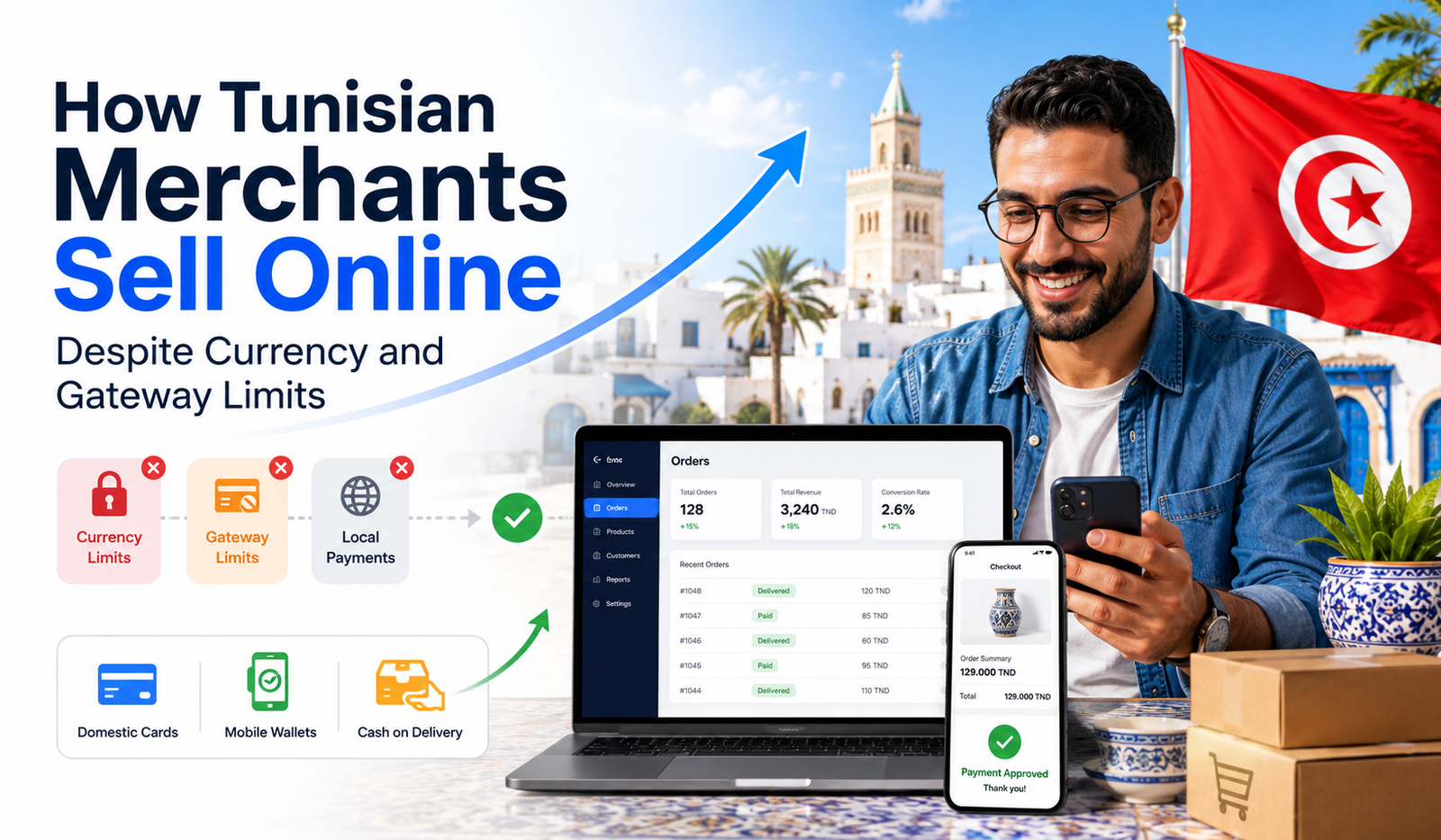
Two things shape the local scene. First, the Tunisian dinar is not freely convertible, and the central bank limits how money moves across borders. Second, the big global gateways are largely unavailable to Tunisian businesses.
The result is a market that runs on local methods. To pay or get paid online in Tunisia, you use tools built for the country, not the global default.
Once you understand that, the rest of this guide is straightforward.
It also helps to drop one assumption early. A method being missing in Tunisia is rarely about the country being behind. It is about rules and infrastructure that global platforms have not adapted to.
2. Local Bank Cards
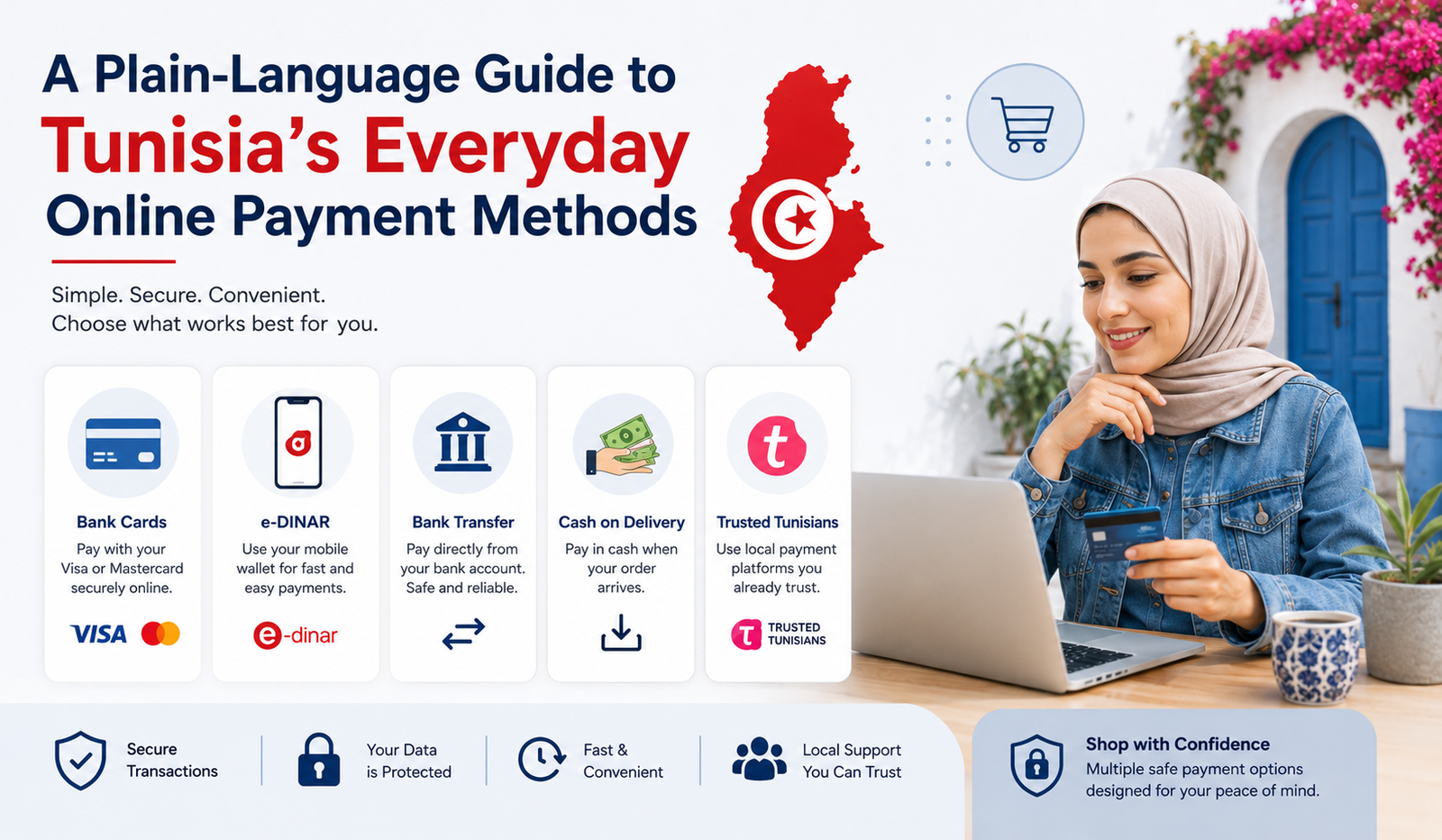
Most Tunisians who pay online use a local bank card. These are ordinary Visa or Mastercard-branded cards issued by Tunisian banks, and they work in dinar on Tunisian websites.
The technology behind most of this is ClicToPay, run by Société Monétique Tunisie. When you pay by card on a Tunisian site, there is a good chance ClicToPay is handling it in the background.
One thing to know: these cards are usually approved for local, dinar payments only. They are not meant for buying from foreign websites, which we will come back to later.
For everyday domestic shopping, though, a local card is the standard, trusted option.
Nearly every Tunisian bank issues these cards, so for buyers who bank locally, paying by card online needs no extra sign-up. That familiarity is a big part of why cards sit at the centre of digital payment.
3. Mobile Wallets
Tunisia is a phone-first country, and mobile wallets have grown fast. They let people pay from an app or by scanning a QR code, without typing card details each time.
The best-known is Flouci, a Tunisian app that lets users pay from a wallet balance or a linked card. It is widely recognised and increasingly accepted online.
D17, offered through the postal service, is another wallet gaining users. Between them, wallets are becoming a normal way to pay, especially for younger shoppers.
For a store, offering at least one wallet is a simple way to reach buyers who prefer their phone to a card.
Paying by QR is worth explaining simply. The buyer opens the wallet app, scans a code shown at checkout, and confirms. There are no long card numbers to type, which suits mobile shopping well.
4. The e-Dinar and Postal Options
The Tunisian postal service, La Poste Tunisienne, offers its own payment tools. The best-known is the e-Dinar, a prepaid account you top up at a post office.
Because it is prepaid and tied to the post office network, e-Dinar reaches people who may not have a bank card, including many outside the big cities.
It is a smaller piece of the picture than cards or wallets, but for some buyers it is the method they know and trust.
You do not need to offer every postal option to serve these buyers. Simply recognising that some customers prefer a prepaid, post-office-based method is enough to shape how you present checkout.
5. Cash on Delivery
Cash on delivery is exactly what it sounds like: the buyer pays in cash when the parcel arrives at the door. It remains the most common way Tunisians pay for online orders.
Buyers like it because they can see the product before paying, which removes the worry of sending money for something that might not arrive or match the description.
For sellers it is essential but costly, since refused deliveries and returns add up. Most stores offer it anyway, because many buyers will not order without it.
It is worth setting expectations. Cash on delivery usually lets the buyer inspect the parcel but not test the product in depth, and policies on refusing an order at the door vary from one courier to another.
6. Bank Transfer
Some buyers, especially for larger purchases, prefer a direct bank transfer. The buyer moves money from their account to the store’s account, and then the order ships.
It avoids card and delivery-payment issues, but it is slower and more manual. It suits higher-value or business-to-business orders more than everyday shopping.
Most consumer stores treat bank transfer as a secondary option rather than a main one.
7. What About PayPal, Stripe, and International Cards
This is where newcomers often get stuck. PayPal and Stripe, the names people expect, do not fully work for Tunisian businesses.
A Tunisian business cannot open a standard Stripe account, and a Tunisia-based PayPal account cannot reliably receive money and withdraw it locally.
Local cards are also blocked from most foreign-currency purchases because of currency controls. There is a special technology card for limited international buys, but it has annual caps and narrow uses.
The takeaway is simple: for selling to Tunisian buyers, you rely on local methods. Global tools are the exception, not the foundation.
This is not a permanent state. The rules are slowly changing, including new foreign-currency accounts for residents, but for now the local-first reality is what a store has to plan around.
8. Which Methods a Store Should Offer
You do not need every method. You need the few that cover your buyers:
• Local cards: the baseline for domestic online payment.
• A mobile wallet: to reach phone-first buyers, such as Flouci users.
• Cash on delivery: to capture cautious and first-time shoppers.
• Bank transfer (optional): useful for larger or business orders.
Two or three of these usually cover the vast majority of Tunisian shoppers. The right mix depends on what you sell and who buys it.
A useful rule of thumb: start with what most of your customers already use, then add methods as you notice buyers dropping off for lack of an option.
Managing several at once is easier through a single connection. A payment mediation platform links a store to multiple local methods through one integration, so you can offer a fuller set of local payment methods for Tunisian stores without wiring up each one. Platforms such as UnumPay work this way for Shopify stores.
However you build it, the aim is the same: give people the checkout options for Tunisian buyers they already recognise, so paying feels easy rather than foreign.
FAQs
What is the most common way Tunisians pay online? Cash on delivery, followed by local bank cards and, increasingly, mobile wallets.
Can I use PayPal or Stripe in Tunisia? Not reliably for a Tunisian business. Both are heavily restricted, so local methods are used instead.
What is ClicToPay? A Tunisian payment service that processes local bank card payments for many websites in the country.
What is Flouci? A popular Tunisian mobile wallet app that lets people pay from a balance or a linked card, often by QR.
Do Tunisian cards work on foreign websites? Usually not. They are limited to local, dinar payments by currency rules.
How many payment methods should a store offer? Usually two or three that match its buyers, such as cards, a wallet, and cash on delivery.
The Bottom Line
Tunisia’s online payment methods are not complicated once you see the logic. The country runs on local tools, because global ones mostly do not work here.
For shoppers, that means paying with a local card, a wallet, the e-Dinar, or cash on delivery. For sellers, it means offering the handful of methods buyers already trust.
Get that mix right, in dinar and with a familiar checkout, and paying online in Tunisia becomes simple for everyone involved. For stores mapping their Tunisia ecommerce payment options, that is the whole game.