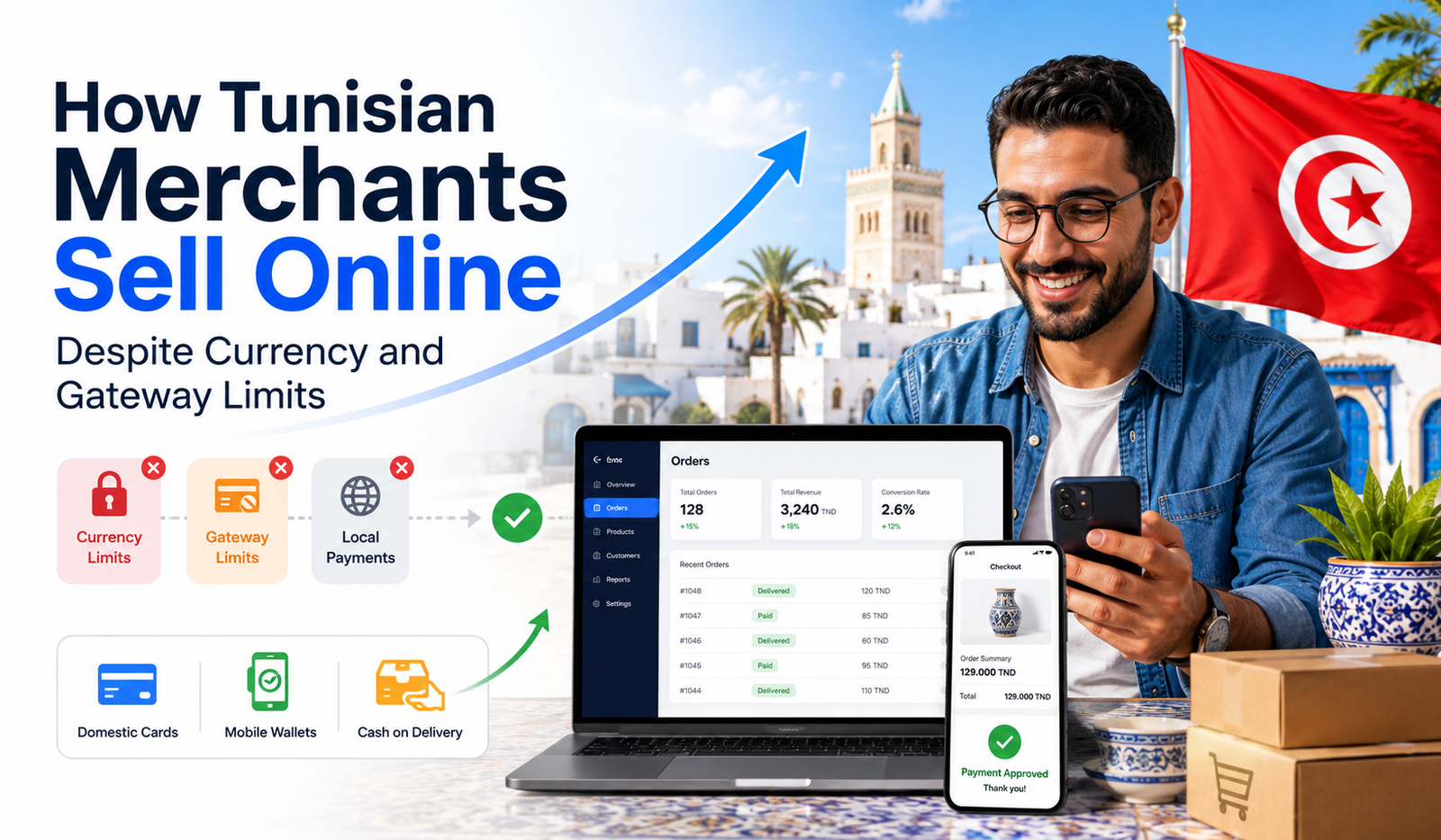
Tunisia’s online retail market has grown steadily, yet the merchants behind it work within constraints that would stop sellers in many other countries. The global payment platforms that power e-commerce elsewhere, from Stripe to PayPal to Shopify Payments, do not fully operate in Tunisia, and the country’s currency rules limit how money moves across borders. On paper, this looks like a market that should struggle to sell online at all.
In practice, Tunisian merchants have built an active e-commerce scene by working with the tools that do exist rather than the ones that do not. This post looks at how they do it: the local payment rails they rely on, the role of cash, how they handle cross-border sales, and why a flexible, multi-provider approach has become the norm.
Table of Contents
• The Constraints Tunisian Merchants Work Around
• Local Card Payments and the Dinar
• Mobile Wallets and the Shift to Digital
• Cash on Delivery: Still the Backbone
• Handling Cross-Border Sales
• A Multi-Provider Approach
• FAQs
1. The Constraints Tunisian Merchants Work Around
Two structural limits shape online selling in Tunisia. The first is gateway availability. The international processors that merchants in Europe or North America take for granted are largely closed to Tunisian-registered businesses, so the familiar one-click setup is not an option.
The second is currency. Tunisia operates tight foreign-exchange controls overseen by the Banque Centrale de Tunisie, and the dinar is not freely convertible. These rules restrict the cross-border movement of funds that global platforms are built on. Reform is underway, including the introduction of foreign-currency accounts for residents, but for now merchants plan around the system as it stands. The result is a market that has learned to rely on local infrastructure.
2. Local Card Payments and the Dinar
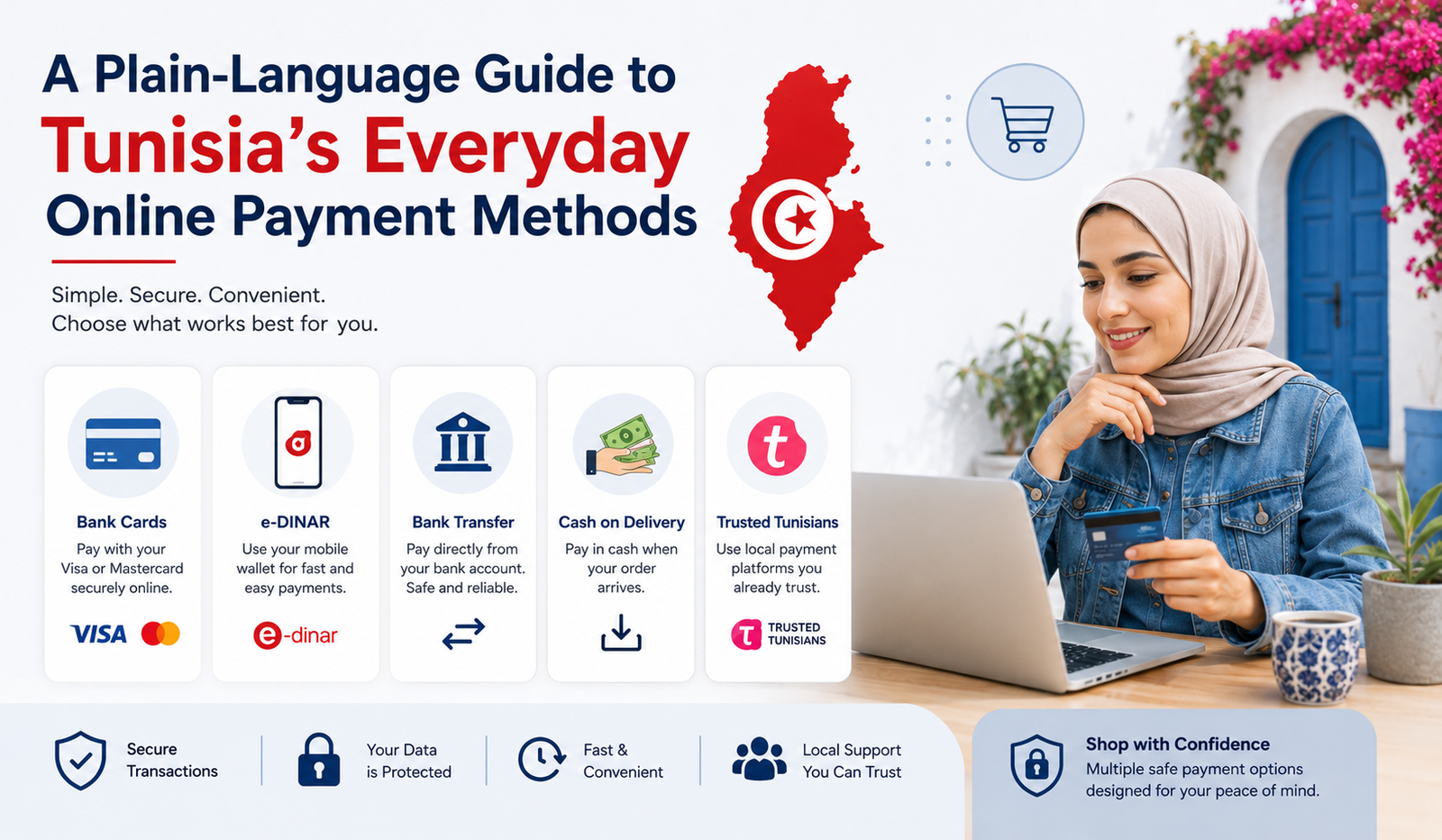
Card payments in Tunisia run on local rails rather than international gateways. ClicToPay, operated by Société Monétique Tunisie, has been the established route for accepting Tunisian bank cards since the mid-2000s and remains common among larger merchants and institutions. It processes domestic card payments in dinar, which is exactly what most Tunisian buyers carry.
For smaller sellers, a newer generation of local providers such as Paymee and Konnect has made card acceptance far easier to set up, often through ready-made plugins and APIs rather than lengthy bank contracts. The e-Dinar wallet from La Poste Tunisienne adds another widely used local option. Together these give Tunisian merchants a practical way to take card and wallet payments in their own currency without depending on a foreign processor. For Shopify sellers specifically, these local rails can be brought into the checkout through Shopify payment options for Tunisia.
3. Mobile Wallets and the Shift to Digital
Tunisia is a mobile-first market, and digital wallets have become central to how younger buyers pay. Flouci, a Tunisian payment app, lets customers pay from a wallet or a linked card, often by scanning a QR code at checkout. Merchants adding it to a Shopify store can follow a Flouci integration guide for Shopify to connect it. The D17 wallet has gained ground quickly as well, and buy-now-pay-later options are beginning to appear.
This shift matters because it widens the pool of buyers a store can reach. A shopper who does not hold an international card, or who simply prefers paying from a phone, can still complete a purchase. For merchants, supporting at least one local wallet alongside cards has become a standard way to capture this growing segment.
4. Cash on Delivery: Still the Backbone
Despite the rise of digital payments, cash on delivery remains one of the most important payment methods in Tunisia, accounting for a large share of online orders. For many buyers, particularly first-time customers and those outside major cities, paying in cash when the parcel arrives is the option they trust most.
For merchants, cash on delivery is both an asset and a cost. It removes the payment barrier for cautious buyers, but it brings higher return rates and slower cash flow. Most Tunisian stores treat it as essential rather than optional, offering it alongside digital methods so that no buyer is turned away for lack of a payment they are comfortable with.
5. Handling Cross-Border Sales
Selling to customers abroad is where Tunisia’s currency rules bite hardest. Because the dinar is not freely convertible and local cards are generally restricted from foreign-currency transactions, merchants cannot rely on the same gateway to serve both local and international buyers.
Those who do sell across borders tend to handle it separately, whether through specialist services used by freelancers and exporters, or by structuring part of their operation to settle foreign earnings in line with the rules. For most Tunisian stores, the core business is domestic, and the priority is getting local payments right first. Cross-border capability is added deliberately, where the rules and the demand justify it, rather than assumed from the start.
6. A Multi-Provider Approach
The common thread across successful Tunisian online stores is that they do not depend on a single payment method. A store typically combines local card acceptance, at least one wallet, and cash on delivery, so that every buyer finds something familiar at checkout.
Running several providers does create work: separate integrations, separate dashboards, and separate reconciliation. To manage this, some merchants use a payment mediation platform, which connects a store to multiple providers through one integration and brings reporting together in a single view. Platforms such as UnumPay take this approach for Shopify merchants, linking local and international options through one connection. For sellers comparing local payment methods for Tunisian stores, the appeal is being able to offer several checkout options for Tunisian buyers without managing each one by hand.
FAQs
Can Tunisian merchants use Stripe or PayPal to sell online? Not in the usual sense. Both are heavily restricted for Tunisian businesses, so merchants rely on local providers instead.
What payment methods do Tunisian online shoppers prefer? Local bank cards, mobile wallets such as Flouci and D17, and cash on delivery, which still accounts for a large share of orders.
Why is cash on delivery so common in Tunisia? It removes the trust barrier for cautious and first-time buyers, especially outside major cities, even though it raises costs for merchants.
How do Tunisian stores handle international customers? Usually through separate arrangements, since currency controls limit how local payment methods work for cross-border sales.
Are Tunisia’s payment limits changing? Reform is in progress, including foreign-currency accounts for residents, but merchants should plan around current rules.
The Bottom Line
Tunisian merchants sell online not by overcoming the country’s currency and gateway limits head-on, but by building around them. Local card rails, mobile wallets, and cash on delivery together cover how Tunisians actually pay, and a multi-provider setup keeps that coverage reliable. The lesson for any merchant in a constrained market is the same: the goal is not the payment tools the rest of the world uses, but the ones customers can and will use.